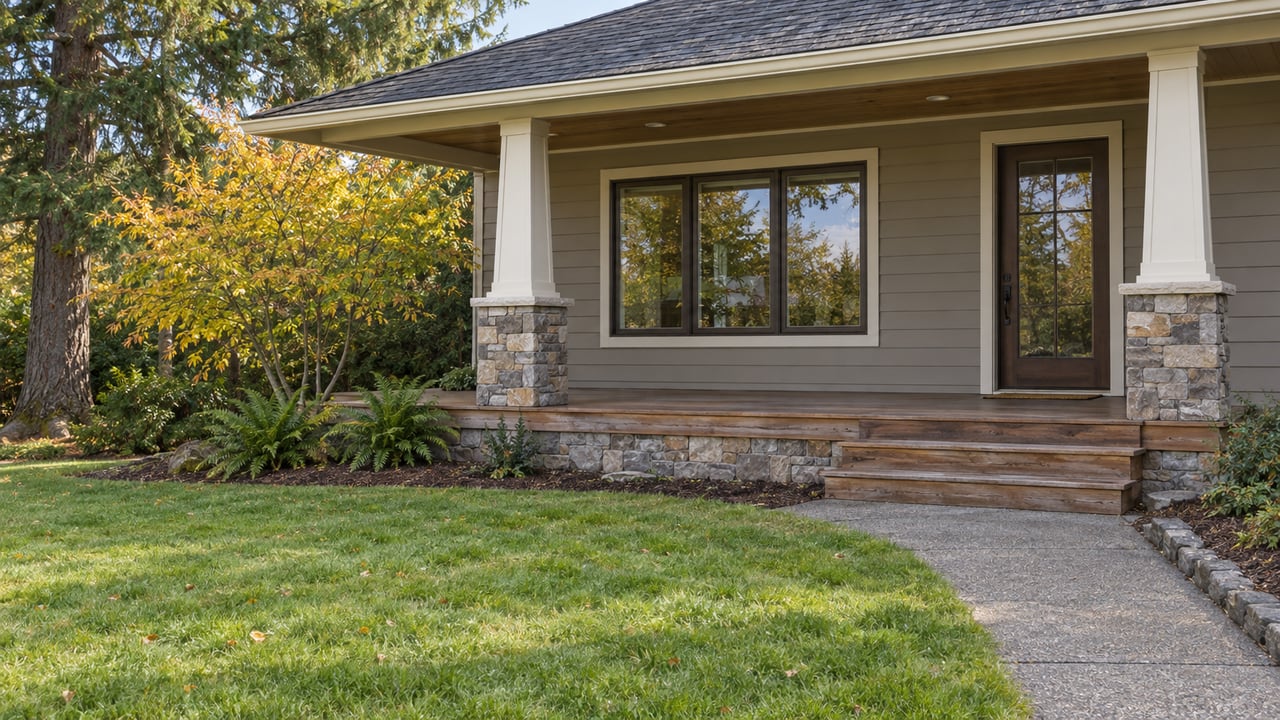
Near Jamestown, a New Well Comes With a Water Budget. Here's How It's Set.
October 15, 2026
October 15, 2026
On the Jamestown side of the Dungeness Valley, much of a buildable lot's water is decided on paper before anyone drills. The Dungeness Water Rule took effect January 2, 2013. Under it, most new groundwater use needs an approved mitigation plan in place before the water is used. For a typical new home, that means buying a mitigation certificate, recording it on the property, and agreeing to a daily cap on water use.
The size of that cap, and whether you can buy outdoor water at all, depends on where the parcel sits. That makes the water budget part of what you're buying when you buy a lot, and two lots that look identical on a listing sheet can come with different ones.
The rule covers the Dungeness watershed from the Morse-Bagley divide east to the Bell-Johnson divide. The Elwha-Morse basin is excluded. The boundary follows drainage divides, not roads, so a parcel has to be checked against the rule-area map. A Sequim mailing address doesn't settle it.
Inside that area, a new well is allowed only when public water service is not "timely and reasonable." The owner has to give Ecology or the county written evidence that service isn't available before the well goes into use. Once that's settled, most owners building a single home get their mitigation from the Dungeness Water Exchange, which Washington Water Trust runs. These are the packages it currently lists:
| Package | Daily amount | When it applies | Posted price |
|---|---|---|---|
| Indoor | 150 gallons | Year-round | $5,250 |
| Basic outdoor | 210 gallons, sized for 2,500 sq ft of turf | April 15 to September 15 | $5,250 |
| Stockwater | 180 gallons, up to 15 animals | Year-round | $5,250 |
The fine print shapes what kind of homestead a lot can support. The indoor package covers only "minimal incidental outdoor use," such as washing windows or watering potted plants in the footprint of the home. Stockwater counts ungulates only: cows, sheep, pigs, horses, llamas, donkeys. Chickens, ducks, dogs and cats don't need it. If you want a house, a lawn and a couple of horses, all three posted packages add up to $15,750 before the well is drilled.
The Exchange's FAQ said it would start reviewing prices in 2025. As of this October the packages page still lists $5,250 each, and no published result of that review turned up in our research, so get a current quote for any specific parcel.
Under state law, a permit-exempt well can draw up to 5,000 gallons a day and irrigate up to half an acre. Inside the rule area, any new consumptive use has to be mitigated. People who buy Exchange packages agree to limit their use to the amount they bought, and a note on the property title records that limit. Half an acre is roughly 21,780 square feet. The basic outdoor package is sized for 2,500. An owner who wants the full exemption can write their own mitigation plan and work directly with Ecology instead of the Exchange.
The outdoor and stockwater packages aren't offered everywhere. The Exchange sells them only in the part of the rule area it calls the "Green Zone." The reason is in how it calculates impact. Each new well is scored by its effect on flows in the Dungeness River and eight small creeks: Bagley, Bell, Casselary, Gierin, McDonald, Meadowbrook, Matriotti and Siebert. The calculation runs on Ecology's 2008 groundwater model and uses two parcel-specific inputs, the property's location and the depth of the aquifer the well draws from.
The model also treats indoor and outdoor water very differently. Indoor use on a septic system is assumed to be only 10 percent consumptive, because most of that water goes back into the aquifer. Irrigation is assumed to be 90 percent consumptive. That gap explains why indoor water is available throughout the rule area while lawns and pastures depend on location. A lawn removes nearly all the water it gets from the system, so where the well sits matters much more.
The Exchange's online locator lets you click a map point or search an address to see whether a location qualifies. None of the public material we reviewed describes the Green Zone boundary in words, so the only reliable answer for a particular Jamestown Road parcel comes from the locator or the Exchange itself.
For new construction, the Exchange issues the certificate after payment. The applicant then signs it, has it notarized, and records it with the Clallam County Auditor, and all of that has to happen before the building permit is issued. The Exchange estimates 6 to 8 weeks for a building-permit certificate. For a land division, it gives 2 to 4 weeks for an availability determination and another 6 to 8 weeks for the final certificates. New withdrawals are also metered, and the Exchange says Ecology-funded meters are provided through January 19, 2028.
An existing home is a different case. The rule protects water uses established before it took effect, so buying a house with pre-rule use isn't the same as creating a new use. Group systems have their own wrinkle. A connection to a group system made within five years of that system's first regular residential use is protected. The Exchange's FAQ says some later Group B connections need mitigation and a meter. County staff decide whether a given applicant has to connect to a water system, buy mitigation, or qualifies under an existing use.
Many parcels in the valley have irrigation ditch shares, so the ditch can look like a way around the outdoor limit. It is a separate system with its own rules. The Sequim-Dungeness Valley Agricultural Water Users Association has seven members: Agnew Irrigation District, Clallam Irrigation Company, Cline Irrigation District, Dungeness Irrigation Company, Dungeness Irrigation District, Highland Irrigation District and Sequim Prairie Tri Irrigation Company.
The Association's rules describe irrigation rights as appurtenant to members' land. Water is delivered to a single point on each 40-acre tract, and the users handle distribution from there. The season runs April 15 to September 15, the same window as the Exchange's outdoor package. Ditch water isn't for household or drinking use. Combined lawn, landscaping and garden irrigation from the ditch is capped at one acre. In a drought, deliveries can be cut back pro rata.
The rules don't explain how a particular share changes hands at a sale. To find which entity serves a parcel, the Clallam Conservation District has an interactive map with layers for Agnew, Clallam Company, Cline, Dungeness Company and District, and Sequim Prairie Company. You click a shaded area to get the entity's contact information.
The drought-curtailment clause was tested this summer. Ecology declared a statewide drought emergency on April 8, 2026, citing near-record low snowpack, and we found no notice ending it.
On July 27, the Peninsula Daily News reported a local hydrologist's reading of the Dungeness at about 140 to 150 cubic feet per second (cfs). At 120 cfs, the river would be in the "critical low" range, where irrigation companies that divert from it may curtail or stop withdrawals. The same report estimated 8,000 to 10,000 individual wells in the Sequim-Dungeness watershed and said farms and fish would feel low flows before household wells. By August 12, the Sequim Gazette reported the river at "critically low levels" and noted Washington was in its fourth straight year under a statewide drought declaration.
The Jamestown S'Klallam Tribe has described the irrigation arrangement this way: diversions start dropping at 120 cfs and stop completely at 62.5 cfs, according to Northwest Treaty Tribes. We found no confirmation that the river hit that lower cutoff this year. The Conservation District's Dungeness Drought Watch 2026 said partners could run up to four pulse flows, closing irrigation gates for about 12 to 24 hours each. It asked shareholders to keep their email on file with their irrigation entity up to date so they'd get notices. In September, Washington Water Trust reported that pulse flows had been triggered with farmers and the Tribe. Its August and September dry-year leases kept more than 1,300 acres' worth of irrigation water in the river, and the program is moving to five-year agreements covering 1,000 to 1,500 acres' worth over the next four summers.
Ditch water arrives in a set season, through a delivery point and a share record, and this year showed that in a dry summer it can be reduced or paused.
Does buying an existing home with a well mean buying mitigation? Not automatically. The rule protects water uses established before it took effect. Whether that covers a specific property, or a later Group B connection, is a question for the county and the Exchange.
Can a buyer see what a recorded certificate allows? Exchange buyers agree to limit use to the amount they bought, and that limit is noted on the property title. A title report can show it.
Is there an easy way to follow the river during irrigation season? In October 2025 the Sequim Gazette reported on a free app that shows current Dungeness River flow, with condition categories and recommended actions for people who use irrigation water or spend time on the river.
If you're weighing a Jamestown-area parcel, or getting land with a well or ditch shares ready to sell, we can help you collect the Green Zone result, the title notes and the irrigation records before price comes into the conversation. Shawnna and Trisha at Trisha J Cobb work through these water questions with land buyers and sellers in the Dungeness Valley. Let's Connect.
This article is general information, not legal, tax or financial advice. Consult a qualified professional about your situation.
Stay up to date on the latest real estate trends.
With decades of combined experience and strong community connections, our team helps buyers and sellers move forward with confidence. Trisha Cobb & Shawnna Rigg are committed to providing attentive service, honest communication, and local expertise throughout every stage of the real estate process.