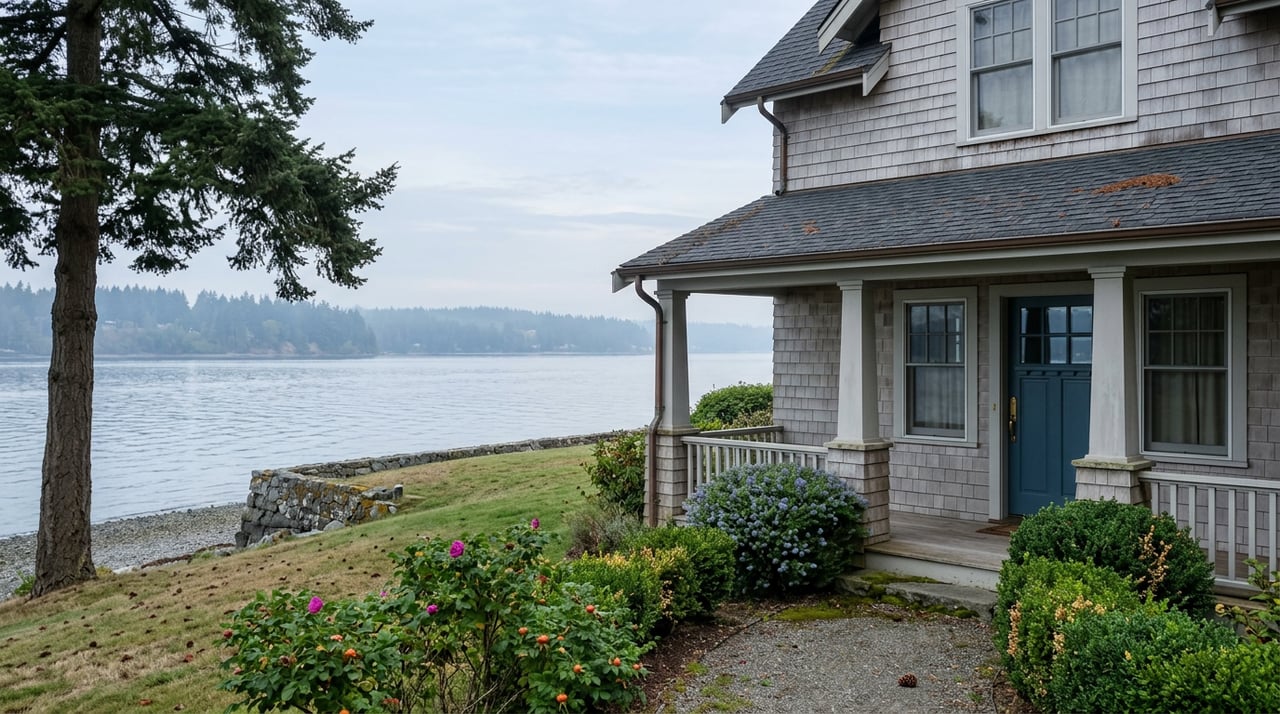
Blyn Jamestown Community News and August 2026 Changes
August 13, 2026
August 13, 2026
Drive Highway 101 between Sequim and Discovery Bay and Blyn takes about ninety seconds to pass. A gas canopy, a casino marquee, a golf course sign, a trailhead pullout with a couple of cars in it. Most people who live out this way think of Blyn as the short stretch where you top off the tank and maybe grab a sandwich before continuing on. That read isn't wrong. It's just incomplete.
Two announcements out of the Jamestown S'Klallam Tribe this year point in opposite directions, and together they say something about Blyn that the pull-off doesn't: the village is pulling one long-standing service out toward Sequim while asking the federal government to hand it direct control over roughly 900 acres spread across two counties and a barrier island. A place that small doesn't usually get to make moves that size. Blyn is making both at once.
Before the two 2026 stories, it's worth being specific about what's already there, because the contrast only lands if you know the baseline.
That's the footprint most residents actually see. It's small enough to walk in an afternoon. The two stories below cover ground that isn't.
Signal one: a core service is leaving. In February, the Sequim Gazette reported that the Jamestown S'Klallam Tribe Family Dental Clinic is moving out of Blyn, where it's operated since 2004, into a new building on the 800 block of North Fifth Avenue in Sequim, next to the Jamestown Family Health Clinic. The current Blyn site sees about 5,800 patients a year, split between roughly 2,700 patients under 19 and 3,100 adults. The problem, according to healthcare senior advisor Cindy Lowe, isn't that the clinic is failing. It's that demand has outgrown a building that can't be expanded further on its current lot. The new facility will run 15,740 square feet with 96 parking stalls on 2.8 acres, built by contractor Korsmo on roughly a 12-month timeline, with separate waiting areas for pediatric and adult patients and, per dental director Dr. Bri Butler, nearly double the daily appointment capacity once complete.
For a Blyn resident, that's a real tradeoff. Dental care that used to mean a quick stop on Old Blyn Highway becomes a six-mile drive into Sequim. In exchange, the wait for an opening should get shorter, since the tribe says the current site turns away more families than it can fit.
Signal two: land control is expanding. Two months later, the Gazette covered a very different kind of move. Tribal Chairman and CEO W. Ron Allen met with U.S. Representative Emily Randall to discuss the Jamestown S'Klallam Land Transfer Act of 2026, which would move federal land into tribal trust ownership rather than tribal management alone.
| Parcel | Approximate acreage | Current arrangement |
|---|---|---|
| Dungeness National Wildlife Refuge and Blyn-area shoreline parcels near Sequim Bay | 608 acres (roughly 144 of that specifically Blyn parcels) | Co-managed day to day by the tribe under a 2024 agreement, owned by U.S. Fish and Wildlife Service |
| Protection Island | 299.8 acres | Managed by the tribe, owned by U.S. Fish and Wildlife Service |
The tribe already runs day-to-day management on both properties under a co-stewardship agreement signed with the Fish and Wildlife Service on August 16, 2024. What this act would change is ownership itself, moving these acres into federal trust status for the tribe, similar to pending transfers for the Lower Elwha Klallam Tribe (1,082 acres) and the Quinault Indian Nation (72 acres). Tribal officials point to the National Bison Restoration Act, which transferred more than 18,000 acres to the Confederated Salish and Kootenai Tribes in Montana, as the model they're following.
The act comes with conditions. No gaming and no commercial development would be allowed on the transferred land. Public access and educational use would have to continue, and the tribe would be required to keep a publicly available management plan. Officials also state there would be no loss of local property tax revenue and that the change is intended to be budget-neutral at the federal level.
As reported by the Sequim Gazette, Allen said, "By Jamestown taking it over, we'll only enhance accessibility, and capacity to educate the community and general community, including tourists." He added, "All upgrades would be maintained by us."
The tribe's climate adaptation planning provides relevant context for the request. It has flagged sea level rise as one of its top long-term concerns, specifically for low-lying areas around Sequim and Discovery Bays, shellfish beds along local beaches, and coastal transportation routes. A federal case study on the tribe's planning process notes that roughly 600 people hold tribal membership, with close to 300 living in the immediate area, a small resident population managing outsized coastal responsibility even before this transfer.
Read against that backdrop, the 2024 co-stewardship agreement looks like a first step and the 2026 trust transfer request looks like the second one. The proposed transfer could have implications for planning sea level response, erosion control, or habitat work. Allen's comment identifies enhanced accessibility and educational capacity as benefits, but does not say the request is about removing a layer of federal process.
None of this touches the Blyn trailhead, which stays exactly where it is, or the golf course, or the deli counter at Longhouse Market. The Olympic Discovery Trail access point opposite tribal headquarters isn't part of either story. If you walk or bike that stretch toward Sequim Bay State Park, the route doesn't change.
What does change, over the next year or two, is where you go for dental care and, potentially, who holds title on land many residents already treat as public, including the Dungeness Refuge trails and the waters around Protection Island. The public access requirement written into the proposed act suggests day-to-day use for hikers, birders, and boaters shouldn't shift much. But ownership matters for anyone who wants to understand who sets the rules on that land going forward, and that's worth watching as the legislation moves through Congress.
Blyn will keep looking like a ninety-second stretch of highway. The decisions coming out of it this year suggest that's no longer the whole picture, and residents who pay attention to both stories will understand the place better than the drive-through version ever tells you.
If you're weighing a move to this corner of the Olympic Peninsula, or you already call it home and want a read on how local changes might touch property values, access, or timing, Trisha J Cobb and Shawnna Rigg have spent decades tracking exactly this kind of on-the-ground detail across Sequim, Port Angeles, and the surrounding communities. Let's Connect.
This article is general information, not legal, tax or financial advice. Consult a qualified professional about your situation.
Stay up to date on the latest real estate trends.
With decades of combined experience and strong community connections, our team helps buyers and sellers move forward with confidence. Trisha Cobb & Shawnna Rigg are committed to providing attentive service, honest communication, and local expertise throughout every stage of the real estate process.